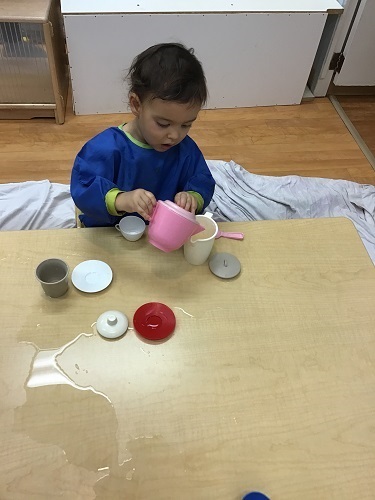
Last week, the infants and toddlers were drinking water from paper cups. Millie kept squishing hers, which led Melody to wonder how Millie and the other children might respond to using plastic tea cups instead. This sparked a fun and engaging water play experience.
The children enthusiastically poured water between different containers: from pitchers to tea cups (and occasionally onto the table), pitcher to spoon, cup to cup, teapot to cup and back again, pitcher to teapot and vice versa, spoon to pitcher (Beau did this even without a lid), and from cup to plate—and the reverse. When the water began to overflow, Beau looked concerned. Melody reassured him, saying, “It’s okay. Try again.”
This activity provided a wonderful opportunity to build fine motor skills and dexterity. The children demonstrated impressive balance as they stacked cups, plates, lids, and pitchers into various tower formations. Felix especially enjoyed this aspect and also discovered he could successfully pour water toward himself from a pitcher into a cup.
Throughout the play, the children engaged in problem-solving, experimenting with fitting lids onto different-sized pitchers and teapots. Millie used a spoon to sip water from her cup, and at one point, turned a pitcher upside down and discovered that banging it in that position helped pop the lid off. Matthias mimicked adult-like behavior, using a pincer grasp to hold the teacup handle while stabilizing the teapot with one hand to pour.
Millie, Felix, Matthias, and Beau showed remarkable focus and engagement, exploring the tea set for extended periods. Melody was intrigued by how this particular group was deeply invested in the pouring and stacking elements, rather than drinking the water from open cups.
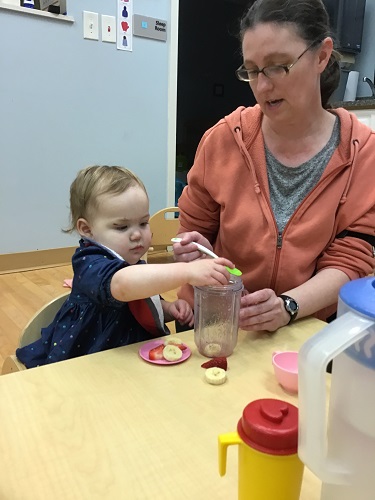
To build on the previous day’s water play, Melody introduced a smoothie-making experience to further support the children’s pouring skills. A variety of ingredients—mandarin oranges, blueberries, bananas, strawberries, and water—were set out. Felix, Matthias, David, and Millie each took turns adding fruit to their individual Magic Bullet cups. Some couldn’t resist tasting the fruit before adding it in!
Using the same pitcher from the day before, the children poured water into their cups. Melody demonstrated how to secure the lid on the Magic Bullet cup and how to push it into the machine to blend the fruit. Once the smoothies were ready, Melody transferred them into a small pitcher and encouraged the children to pour the smoothie into their tea cups.
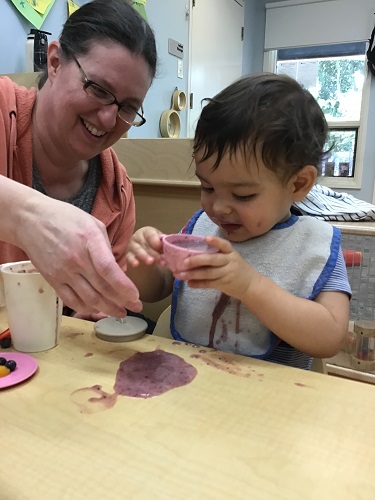
Matthias concentrated carefully, practicing his fine motor skills as he poured without spilling or overflowing. After David poured his smoothie, he covered his teacup with a plate. Melody helped him take a sip, after which he used a spoon to drink the rest before covering the cup again. Melody wondered if he was playing a little game of hide and seek with his smoothie.
The children enjoyed drinking from their tea cups, both independently and with support. Felix made a satisfied “mmmmm” sound followed by a cheerful “ah!” Shannon asked if he liked the taste—he clearly did, eagerly pouring more into his cup again and again. Millie, ever curious, dipped her fingers into her smoothie and licked them—what a fun way to explore new tastes.
Later, Shannon held Micah at the table as he grasped her Magic Bullet cup. Melody asked, “Do you feel the vibration, Micah?” He watched the fruit swirl with fascination and even moved his fingers along the cup, trying to reach the fruit. His curious gesture made both educators laugh. When it was Isaiah’s turn, he shivered at the sound of the machine at first but soon became excited, bouncing on Shannon’s lap and holding the cup with and without help. At one point, he even tried to eat the cup—did it look that tasty?
This experience sparked so much curiosity, joy, and skill-building. To continue this interest, more cooking activities could be introduced in the coming days.