One of the most efficient methods of teaching young children is to provide them with a set of intriguing materials and the time and space to freely explore, as Albert Einstein himself is credited with saying “Play is the highest form of research.” Spring has finally brought us warm sunshine in the mornings, granting us more opportunities to combine our activities with outdoor play, which is always a great way to add exercise and fresh air to any lesson.
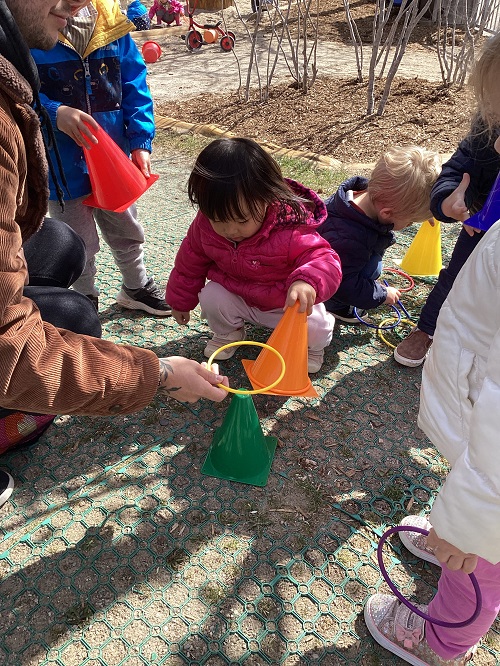
On one sunny morning in May, the educators created a spontaneous provocation for the toddlers by allowing them to explore a colourful ring toss game. These materials are typically reserved for older groups because of the higher level of structure, hand-eye coordination, and challenging gross motor skills; however, many children in the group had recently demonstrated an interest in colour recognition by bringing balls to an educator and imitating the way we often ask them, “What colour is this?” The ring toss set, containing two rings to match each different coloured pylon, became an open-ended material allowing the children freedom to let their own curiosity guide their learning at their own individual levels.
This activity began outside, but because the children seemed so engaged by the materials, it was later brought into the classroom and was used very differently within the two environments. While on the playground, we were able to observe how each child’s unique personality and strengths led them to engage in a certain way. An active and sociable pair of boys were drawn to the sounds that could be made with the cones, first by throwing them onto the pavement and later by cupping them around their mouths and joyfully listening to how it altered their voices. Another boy sat with his rings, lining them up side by side and counting them from one to five. A small group of girls set their pylons on the hill and worked together to dole out the rings so that everyone had some. One boy independently matched the two orange rings to the orange pylon and proudly showed all of his educators. In whatever manner they were used, the toddlers were demonstrating developing skill sets, along with confidence and pride in themselves at whatever was considered a success to them.
The nature of a toddler's usual attention span is that even good provocations sometimes only last for a very short amount of time, so imagine our surprise when it was time for the group to head back inside and many of them seemed like they weren’t finished yet! We were more than happy to gather the cones and rings and bring them into the classroom with us for further exploration. This time we decided to set them all on the table and introduce a level of educator guidance by asking everyone to try and match the colours, narrowing the activity down to focus in on those colour recognition and vocabulary skills.
Having the interested group gather around a table and all work together on a shared task added social development into the mix as children stood shoulder to shoulder and recognized that if they wanted to complete the challenge, they needed to help one another. What seems like a simple game of placing rings on pylons actually becomes practice for a series of foundational skills relating to cooperation and communication that children will use all throughout school — and most likely beyond.
Whether it was vocabulary, numeracy, sharing materials, or just sharing in joy, the toddlers’ individuality shone as their interest led them in learning through play.